
CEO Newsletter – September 2026
Yesterday, as I walked down the corridor towards my office, I noticed an elderly woman sitting quietly outside.
Without thinking, my head dropped slightly and my eyes went to her feet rather than her face. It was instinctive. I had immediately assumed a cultural position of respect. Then, momentarily, I came back into myself and into the context I was in. It was okay to look her in the eye. It was okay to greet her.
So I did.
Just as I did, she began coughing vigorously. I waited until she was ready, we acknowledged each other and I continued towards my office.
A little later I went looking for one of my colleagues and found Faith. I mentioned the woman sitting outside. Faith had already seen her and had brought her a glass of water. It was such a small thing, but in that moment, I felt that familiar warmth of knowing I work in an organisation that tries to live the vision it speaks about.
Belonging is not an abstract idea. Sometimes it is simply noticing someone. Sometimes it is a glass of water.
Last month marked ten years since I first walked through the doors of Melaleuca Australia, then known as the Melaleuca Refugee Centre.

I remember finding a community of thoughtful people deeply focused on service. There was heart. There were hands doing the work. And there was an organisation with enormous potential.
Much of that first year, for me, became about connecting heart and hands with head. How do we remain deeply relational while also being accountable? How do we build systems without allowing the systems to become more important than the people they are meant to serve? How do we make an organisation sustainable without losing its soul?
Over the years, we have pulled things apart, examined them and put them back together. People. Resources. Systems. But what has always had to glue them together is honour and dignity.
Ten years later, I think I understand that even more deeply.
Sometimes I am asked what I actually do from day to day. My answer is that I listen and I do slow things. Things that take time to build, and things whose results I may not see while I am still here.
Every day I either start something or continue something. Some of those things began long before my time and, hopefully, some will continue long after it.
Because settlement itself is slow. It is not simply about visas, houses, jobs and schools. Of course it is about all of those things, but it is also about everything that is human.
It is the bus ride. The haircut. The shopping aisle. Going to the doctor. Filling in a form. Understanding a letter. Finding friends. Raising children. Growing older. Grieving somebody far away. Learning when to look someone in the eye and when respect asks you to lower your gaze.
It is birth and death and all of the wonderfully ordinary things in between.
And sometimes it is about being counted.
Australia recently held its national Census. For most of us, a Census is an ordinary civic exercise. We fill it in, submit it and move on.
For many of the people and communities we work alongside, particularly those experiencing an Australian Census for the first time, it can feel very different.
Why am I being counted? Do I belong enough to be counted? Will this information affect my visa? If I say how many people live in my house, will I lose my home? What happens if I tell the government what I earn?
These fears do not simply come from people not trusting a system. For some, they come from experiences in places where providing information to authorities has carried very real consequences.
Then we place in front of someone a long Census form, written within a system that largely assumes a level of English language and literacy, and ask them to participate. It raises a bigger question: if I cannot understand the process designed to count me, do I count within it?

That mattered to us.
So across Melaleuca, people got to work. We worked with the government. We connected with community leaders. We joined with organisations across the Top End and Central Australia. We helped raise awareness, created spaces where people could get support, answered questions and worked to dispel myths. Across the organisation, conversations about the Census could be heard everywhere.
Because data tells stories. And if people at the margins are missing from the data, their stories can remain missing from the decisions that data informs.
Everyone counts.
That same principle has found its way into so much of our work over these past months.
Through our partnership with Migration NT and the Harnessing Opportunities for Migrants into Employment, or HOME, program, we are connecting with skilled migrants before they have even left their countries.

There is something quite special about that. Before the plane, before the new house, before the first day at work, there is somebody here saying: we know you are coming. Let us help make this unfamiliar place a little more familiar.
I watch our colleague Hoa quietly and calmly creating those connections, helping people imagine themselves here before their journey has even begun.
That is hope in practice.
We have also spent considerable energy over recent months working to protect refugee health coordination in the Northern Territory. The service was at risk of ending on 30 June.
Behind the language of funding and programs was something much more human. People arriving in the Territory need comprehensive health assessments. Children need immunisations. Families need to understand how to navigate a health system they have never encountered before. People need to be connected to the right care.
Losing that coordination would have mattered, not only to newly arrived families but to public health across the Territory.
It took many people and organisations working together to keep that work going, and I remain deeply grateful to the Northern Territory Government, Northern Territory PHN , Australian Government agencies and our national multicultural health colleagues for standing with us. I am particularly grateful to Luke Gosling OAM MP for his continued support and faith in the work we do.
And then there are our community leaders.
Every day, community leaders carry extraordinary stories. They carry pride in their cultures and hope for their growing communities. They are called when someone is struggling, when a family needs help, when there is conflict, when there is celebration and when there is grief. They care for everyone.
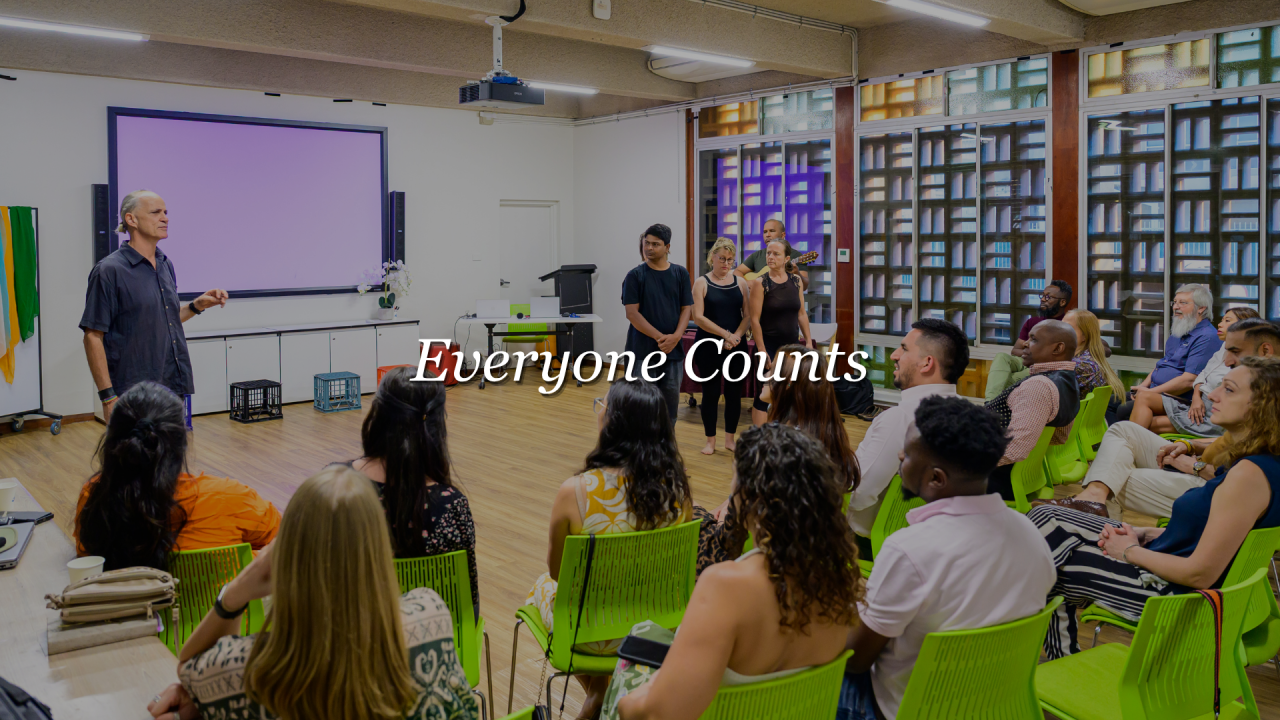
Every six weeks I host our Multilingual Mingle. It is a space for community leaders to come together, share stories, connect and find common ground. For me, it is also an opportunity to care for the people who spend so much of their lives caring for others.
Our most recent Mingle was particularly powerful. We partnered with Playback Theatre and watched as the stories shared by community leaders were brought to life in front of us. We heard them, then we saw them, and somehow we felt them differently.

There is something deeply affirming about seeing your own experience reflected back to you and knowing that somebody else has heard it.
The person who cares for everyone else needs to know that they count too.
That is something we have also had to learn to turn inward.
Six years ago, we established an annual staff culture survey as a way of taking the temperature of our own organisation. It was important to us that while we spoke about belonging in the communities we serve, we were also willing to ask the same questions of ourselves.
Do the people who care for others every day feel heard themselves? Do they have what they need to do their work well? Do they feel valued? Do they feel that they count?
This year we completed the survey again and recorded our highest staff participation since it began. The results showed an exceptional upward trend across our organisational culture. After six years of asking, listening, changing things and asking again, that was deeply affirming.
But what matters to me just as much as the results is that our people participated. They told us what is working. They told us what they need. They gave us an honest temperature of the organisation they experience every day.
Because belonging cannot only be something we seek to create outside our walls. The people doing the caring need to experience it too.
Their voices count.
Perhaps that is also why the NT Human Rights Awards remain so close to my heart.
I have been involved with the Awards for much of the past ten years and have had the honour of chairing the Convening Committee for the past two. As we open nominations again, I have found myself reflecting on two people who helped shape the Awards: Sally Sievers AO , who nurtured them from their infancy, and Jeswynn Yogaratnam, who helped carry them through their next stage of growth.

Both have now left the Territory. I am sad to see them go, but grateful to have witnessed part of their journeys and to now work alongside a remarkable group of conveners who will carry the Awards into their next chapter.
The NT Human Rights Awards nominations close on Friday, 16 October 2026.
Perhaps this is what much of my work has become after ten years.
Listening. Connecting. Creating spaces. Shaping policy. Trying to ensure that voices heard today find their way into the systems and decisions that will shape tomorrow.
Over recent months that has meant contributing to national discussions about violence against women and children and employment services reform. It has meant listening to young people talk about racism and bullying and working with them to strengthen their voice and imagine different responses.
It has also meant welcoming people whose roles remind us that our little corner of Australia is connected to a much bigger world.

I had the honour of meeting with the Ambassador of Colombia, Diego Felipe Cadena Montenegro, through the Colombian Association NT, and sharing in his vision for the growing Colombian community here in the Territory. I also had the opportunity to meet with Dr Wilson Kogo, the High Commissioner of Kenya to Australia, and explore how those relationships can support Kenyans making their lives here.
Last year we also launched the Latin America Film Festival in collaboration with the Council on Australia Latin America Relations, the Colombian Australian Association and Latin American Association Darwin. I am pleased that we will come together again to host the Festival at Melaleuca in 2026.

These may seem like very different pieces of work, but to me they are connected. They are about people seeing themselves in the future of the place they now call home.
And sometimes this work means doing something whose impact may not be visible for years. That is the nature of slow work.
The world around us continues to remind us why that work matters. Conflict, disasters and events thousands of kilometres away do not remain thousands of kilometres away.
They arrive here through people. Through families. Through telephone calls home. Through worry carried quietly into workplaces, schools and community spaces.
The recent earthquake in Colombia has been deeply painful for Colombian communities watching from afar and rallying around those they love. My thoughts remain with them and with everyone affected.
Distance does not make us disconnected.
Which brings me back to the woman outside my office.
I don’t know her whole story, and I don’t need to.
I know that for a few minutes yesterday, somebody noticed her. Somebody brought her water. Somebody waited while she coughed. Somebody looked at her and acknowledged that she was there.
Perhaps belonging begins with things as ordinary as that. Not grand declarations about inclusion. Not strategies or policies or carefully chosen words. But the everyday ways we tell another human being:
I see you. You are here. You count.
And after ten years, perhaps that is the simplest way I can describe what I still hope our work contributes to.
A community in which everyone counts enough to belong