
A woman walked towards safety carrying her most treasured possession – a simple baking griddle (Watch her story).
Not for its value. For what it promised. That one day, in another place, she might cook for her family again, welcome neighbours to her table, share stories and laughter and food, and begin again.
Refugee journeys are so often measured in numbers. But they are lived in moments like that one.
This Refugee Week, communities across Australia gathered to mark a remarkable milestone – Australia’s one millionth refugee and humanitarian visa, celebrated alongside the Refugee Council of Australia and the UN Refugee Agency. It is an extraordinary achievement.
And yet it arrives at a moment when belonging itself is being debated, here and around the world. As wars, conflict and persecution continue to force record numbers of people from their homes, conversations about migration have grown more polarised. Who belongs? Who should be welcomed? Who gets to call a place home?
It is against that backdrop that this milestone feels less like a statistic, and more like an answer.
Ten years ago, as I stepped into leadership as CEO of Melaleuca Australia, I joined fellow CEOs across Australia’s humanitarian settlement sector and the Forum of Australian Services for Survivors of Torture and Trauma FASSTT Conference network who were working to respond to one of the defining humanitarian crises of our time.
The Syrian conflict was unfolding, millions of people had been displaced, and Australia was preparing to welcome those seeking safety and the opportunity to rebuild their lives.
I remember looking at the global displacement figures at the time. In 2016, 65.6 million people around the world had been forcibly displaced from their homes, including 22.5 million refugees.
The scale was difficult to comprehend.
What stayed with me was another figure. Every minute of every day, approximately 20 people were being displaced by conflict, persecution or violence. Today, at the end of 2025, global displacement stands at approximately 117 million people, including 41.6 million refugees.
Almost half of those displaced are children.
In just ten years, the number of displaced people worldwide has almost doubled.
Behind every one of those numbers is a person. A family. A story. A life interrupted. A journey often marked by loss, uncertainty and courage. Children whose lives have been shaped by events beyond their control. Parents making impossible decisions in the hope of keeping their families safe. People who have walked hundreds of kilometres to reach safety. People who have crossed borders carrying little more than hope. People who, despite everything they have endured, continue to contribute, create, rebuild and belong.
That resilience is worth celebrating every day, not just during one week each year.
For Melaleuca Australia, Refugee Week began with reflection.

Our Board gathered to honour Mr Colin McDonald KC, our longest-serving Board member and a lifelong advocate for human rights and humanitarian causes. Listening to Colin share his journey and experiences defending and supporting refugees both in Australia and internationally set the tone for the week ahead. His humility, wisdom and enduring commitment to humanity reminded us that meaningful change is often built quietly, steadily and over many years.
Behind the scenes, a dedicated team had spent months working alongside communities to design this year’s program. I want to acknowledge our Deputy CEO, Erin Plumb , and the many staff, volunteers, artists and community leaders whose long hours and thoughtful planning brought the week to life. Throughout the week, our spaces transformed.
Throughout the week, our spaces transformed.
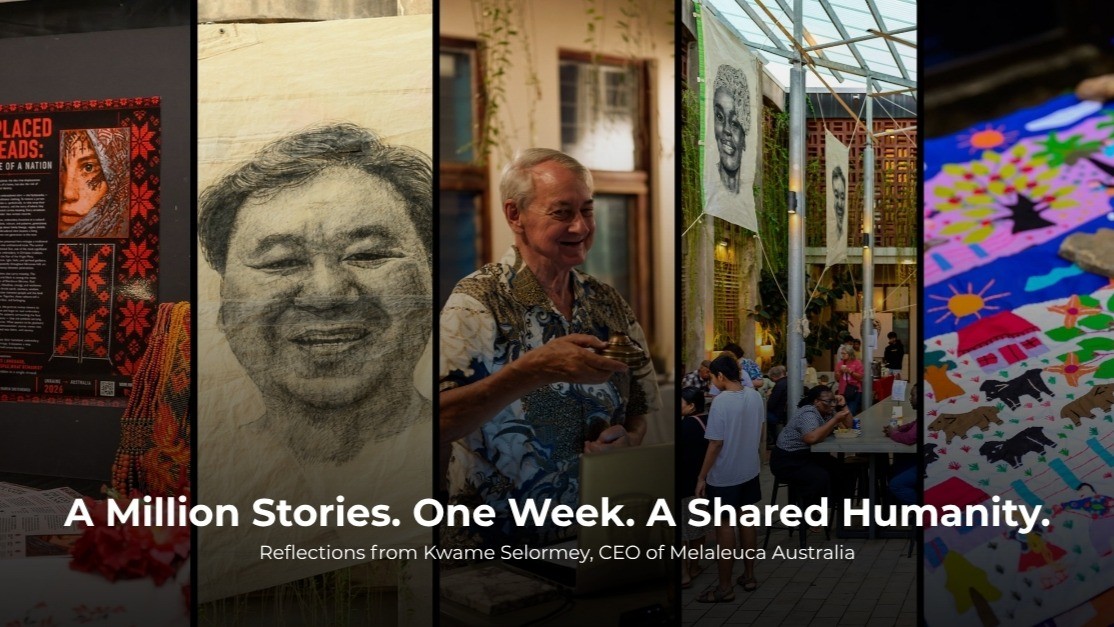
The Mela Kulcha courtyard became a place of colour, creativity and conversation.

Suspended above the courtyard were seven (are six) remarkable faces painted on sails and raised high above us. Together they reflected this year’s theme, A Million Stories. The faces represented people whose journeys, contributions and acts of leadership have helped shape our community.
There was something powerful about seeing those stories carried on sails.
Sails speak of journeys. Of movement. Of uncertainty. Of courage. Of destinations not yet known.
As they moved gently in the wind above the courtyard, they seemed to remind us that even after great upheaval, human beings continue to find ways to rise, rebuild and belong.
Inside, our Refugee Week gallery invited visitors into a different kind of journey.
This year’s exhibition brought together stories, portraits and artworks that reflected hope, resilience, belonging and contribution. Some pieces had travelled through generations. Others were created by young people forging new stories and new futures in Australia.

Visitors could sit quietly, listen to stories and spend time with the artworks. There was no rush. No agenda. Just an opportunity to pause and encounter the lived experiences behind the headlines and statistics.
For me, that is where the theme A Million Stories came to life.
Not in the numbers.
But in the faces, voices, memories and moments that remind us every refugee journey is ultimately a human story.
Midweek brought one of my favourite moments of Refugee Week.
More than one hundred community members gathered at the George Brown Darwin Botanic Gardens to celebrate the completion of their refugee journey and the beginning of a new chapter. There was music, food, dancing, laughter and friendship. There was no agenda beyond connection. For a few hours, people simply gathered as neighbours, friends and community.

Sometimes belonging looks exactly like that.
On Friday evening, Fusion Fest once again opened Melaleuca’s gates to the wider Darwin community.
As people arrived, they were welcomed by the aromas of food from around the world, vibrant cultural dress, music, dance and storytelling. It was a reminder that multiculturalism is not an abstract concept. It is something you can taste, hear, see and experience.
Our keynote speaker moved many of us with reflections on endurance, family and the power of love to survive even the greatest hardships.
The evening also provided an opportunity to honour one of Darwin’s longest-serving refugee community leaders, Mr Le from the Vietnamese community. Hearing his story and reflecting on the generations of leaders he has quietly mentored was deeply moving. His example reminds us that leadership is not always loud. Sometimes it is measured in decades of service, humility, grace and steady commitment to others.
As the week drew to a close, we gathered for our annual candle ceremony.
Each candle represented 500,000 displaced people.

Together they represented the 117 million people around the world who remain on their journey towards safety, belonging and peace.
As we stood together, I found myself reflecting on a simple truth.
We are all here.
But we are also all there.
Connected.
Connected to families rebuilding their lives in Australia.
Connected to communities still waiting in refugee camps.
Connected to people making impossible journeys in search of safety.
Connected by our shared humanity.
On Saturday morning, after the week had ended, I stopped at Australia Post and purchased the commemorative Refugee Week stamps released in partnership with UNHCR, the UN Refugee Agency and the Refugee Council of Australia

I found myself studying the design more closely than I expected.
Across the map of Australia were coloured dots stretching from coast to coast, city to city, region to region.
At first they seemed simple.
Then I realised what I was looking at.
The dots were a reminder that Australia’s humanitarian story reaches far beyond our major cities.
Every dot represented lives rebuilt. Families reunited. Children growing up in safety. Communities enriched by people who arrived carrying little more than hope, resilience and determination.
From one end of the country to the other, refugee and humanitarian communities have helped shape the social, cultural and economic fabric of Australia. Their stories are now inseparable from our national story.
The coloured dots did not simply represent places.
They represented people.
A million stories.
A million acts of rebuilding.
A million contributions woven into the fabric of our communities.
One million refugee and humanitarian visas is not merely a statistic.
It is one million reminders that belonging is not diminished when it is shared.
It grows.
As Refugee Week comes to a close, may we never lose sight of the people behind the numbers, the stories behind the headlines, and the extraordinary contribution that refugee and humanitarian communities continue to make to our nation.
One million stories have now become part of Australia’s story.
May we never stop listening to them